Rhythm Journey
- 4.0
- Rating
- 50.00K
- Installs
- Free
- Price

 Analysis by App-foxy
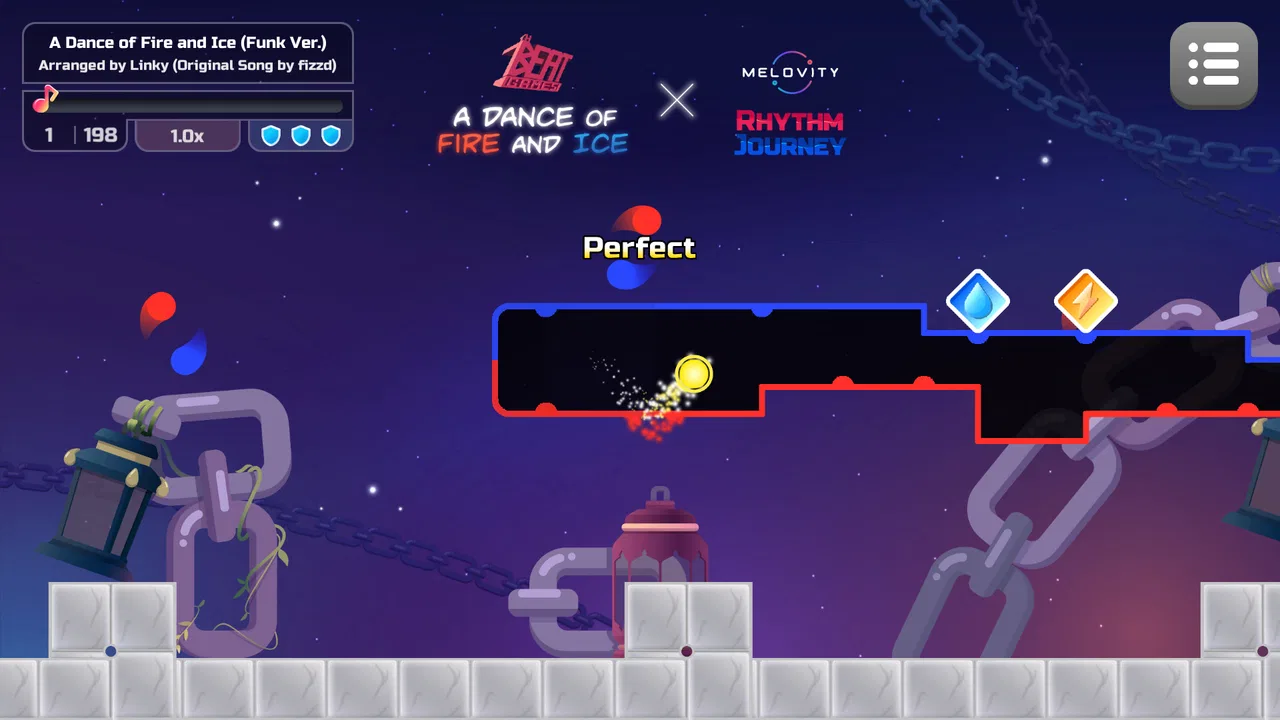
Rhythm games usually ask me to react quickly, but Rhythm Journey takes a more focused approach. It is a free music game from Melovity built around two-button play and a story-led journey, with difficulty aimed at players who enjoy repeating a section until their timing finally clicks. I found that combination immediately appealing: the controls are simple enough to understand in moments, while the challenge comes from reading patterns, staying calm, and making accurate decisions rather than juggling a large control scheme.
That simplicity is also the game’s main test. This is not the kind of music game I would open only to tap along casually for a few minutes without paying attention. Its appeal is closer to learning a demanding song, identifying where I keep slipping, and trying again with a better plan. If you like rhythm games that reward persistence, it has a clear identity. If you mainly want a relaxed soundtrack, a broad song library, or a gentle introduction to the genre, the experience may feel more pressuring than expected.
How the two-button design becomes the whole challenge
The two-button format sounds modest, but it leaves very little room to hide mistakes. Because there are fewer inputs to think about, my attention moves toward timing, visual reading, and anticipating what comes next. That makes each error feel understandable: I am not losing because the controls are complicated; I am losing because I reacted late, misunderstood a pattern, or allowed one mistake to disturb the next beat.
You May Also Like

 AccuWeather: Weather Radar
AccuWeather Review: A Quick, Clear Forecast for Everyday Decisions
For everyday plans, the best forecast is the one you can understand quickly. AccuWeather makes rain timing, radar, and local conditions easy to act on, with a few trade-offs.

 Hill Climb Racing
Why Hill Climb Racing Still Turns Crashes Into One More Run
A tiny car, a bumpy hill and one more upgrade: Hill Climb Racing keeps resurfacing because its simple chaos makes every near-miss feel personal.

 AliExpress - Shopping App
AliExpress Makes Global Shopping Feel Personal, but Shoppers Bear the Risk
AliExpress turns a global marketplace into a pocket-sized discovery engine. Its reach is useful, its shopping loop compelling, and its trade-offs easy to miss.

 Lords Mobile: Kingdom Wars
Lords Mobile Is a Kingdom-Building Routine, Not a Quick Match
A case-by-case verdict on the building, battles, device demands, and social commitments that make Lords Mobile rewarding for some players and exhausting for others.

 PDF Scanner app - TapScanner
TapScanner Makes Paperwork Easier to Capture, Check, and Share
TapScanner makes scanning with a phone feel less like a rescue operation and more like a dependable step in getting work done. Its capture tools are useful, though not flawless.

 Block Blast!
 Shows How Much a Puzzle Game Can Leave Out
A quiet grid game shows why puzzle players increasingly value instant clarity, repeatable skill and low-pressure play—and where the genre still needs to catch up.
More From Our News Desk
View All News


This is a useful distinction from many mobile rhythm games that fill the screen with lanes, gestures, holds, swipes, or several simultaneous actions. Those systems can be exciting, but they also make the first learning barrier about control vocabulary. Here, the basic vocabulary is deliberately narrow. The difficulty has to come from how the game presents musical decisions and how consistently I can execute them.
I would recommend beginning with a patient mindset. The first attempt at a demanding section is often more valuable as reconnaissance than as a serious score run. I try to notice whether my misses happen because I am watching the wrong visual cue, pressing too early, or rushing after a previous mistake. That small habit makes repetition feel purposeful instead of random.
Why the story matters more than a simple menu of songs
The story-based structure gives the game a reason to move forward beyond chasing isolated high scores. I enjoyed having a sense of progression attached to the music, because a difficult passage feels like part of a larger journey rather than just another item on a list. Even when I had to replay a section, the narrative framing helped preserve the feeling that I was advancing through an experience.
That approach will suit players who want context around their rhythm challenges. It is less ideal for someone who treats music games like a jukebox and wants to jump freely between a large selection of tracks. A story can create momentum, but it can also make a player feel more constrained if the current challenge is not the one they want to practice.
For me, the strongest use of the story is motivational rather than dramatic. It gives repeated attempts a destination. I am more willing to spend time refining a difficult sequence when it feels connected to the next part of the journey, even though the immediate activity remains the same fundamental loop: listen, read, press, miss, adjust, and try again.
A practical routine for difficult sections
One of the most useful ways to approach the game is to separate learning from performance. On an early attempt, I focus on mapping the rhythm and identifying the moments that consistently catch me. On the next attempt, I concentrate on one problem rather than trying to produce a perfect run immediately. This prevents a single mistake near the beginning from turning the entire session into frustration.
I also find it better to stop after a few unfocused attempts instead of continuing to press while annoyed. In a two-button rhythm game, frustration often creates a predictable chain: I press early, notice the error, hurry to compensate, and then miss the following input as well. A short break can be more productive than another automatic retry because the challenge depends on attention, not just persistence.
Another useful trade-off is sound versus visual concentration. Players who naturally follow beats may rely on the music first, while others may need to watch the incoming cues more carefully. I would experiment with both approaches rather than assuming one is correct. When the two signals seem to disagree in my head, I focus on understanding the game’s visual timing instead of forcing myself to follow the song in the way I would listen to it casually.
Spending, progress pressure, and what fairness looks like here
The game is free to download and is suitable for Everyone, which makes it easy to try without committing money at the start. It also includes optional in-app purchases priced from $2.99 to $4.49 per item. That is the important purchase context for anyone deciding whether the challenge is worth exploring: the entry point is free, while some items may require spending.
I would not treat those purchases as a reason to assume the game is unfair. The available purchase information does not establish that paid items affect performance, unlock stronger abilities, remove failure, or provide competitive advantages. Because of that, I judge the game first on its core free experience and avoid promising that spending is unnecessary for every kind of progress. A careful player should look at each purchase in context before buying, especially if the goal is simply to experience the story and rhythm challenges.
The most important fairness question for me is whether success feels connected to skill and practice. A difficult stage can be fair even when it is demanding, provided my improvement comes from learning its patterns and controlling my timing. Conversely, a generous system can still feel unsatisfying if it makes the outcome unclear. The two-button design gives the game a good foundation for skill-based play because the action is easy to understand; the pressure comes from execution.
There is also a psychological spending issue that is easy to overlook. Repeated failure can make a player more willing to buy something simply to reduce frustration, even when the purchase does not address the real problem. My advice is to treat a purchase as an optional addition, not as a substitute for learning the rhythm. If I am missing because I have not recognized a pattern, paying will not automatically improve my timing or make the section more enjoyable.
Who will feel comfortable with the pressure
Players who like mastery-based games should find the structure familiar. The reward is not only reaching the next story moment; it is the small improvement between attempts. I enjoy that kind of progress when I can clearly identify what changed: a cleaner entrance, a calmer response after a mistake, or better anticipation of a repeated sequence.
On the other hand, I would hesitate to recommend it to someone who dislikes replaying the same challenge. A story framework may make the journey feel meaningful, but it does not remove the need to practice. Anyone looking for a background game during a commute may also find the concentration requirement inconvenient, particularly when noise or interruptions make precise rhythm input harder.
The age rating of Everyone makes the game broadly approachable from a content perspective, but that should not be confused with low difficulty. A game can be suitable for all ages while still demanding patience and coordination. For a younger player, the two-button layout may be easier to understand than a more elaborate rhythm interface, but the hardcore positioning means the later challenge may still require sustained attention.
How it compares with more conventional music games
Compared with music games that emphasize a large catalog and quick song selection, this feels more like a guided campaign. The story gives it stronger direction, while the restricted controls make the act of playing easier to explain. The trade-off is variety of interaction: players who want many input types or a constant stream of new mechanical ideas may prefer a broader rhythm title.
Compared with very casual tap games, the difference is commitment. A casual tap game may be satisfying because almost every short session produces a pleasant result. Here, a session can end with me understanding a section better but still failing it. That is not a flaw for the intended audience, but it is a meaningful distinction when choosing what to install.
It also differs from rhythm games designed mainly around personal scores. The story focus makes the experience feel less like a spreadsheet of records and more like a sequence of challenges. Players who enjoy comparing numbers may still appreciate the precision, but those seeking extensive competitive tools should not assume that a narrative rhythm game will offer the same kind of score-driven structure as a dedicated arcade-style alternative.
What I would check before committing to a long session
The game was released on January 3, 2022, and its current version is 1.6.10. It supports devices running Android 5.1 or later, so compatibility is relatively broad for older Android hardware. Even so, I would still make sure the phone responds reliably to quick taps before blaming the game for missed inputs. A worn screen protector, inconsistent touch response, or a device struggling with other tasks can turn a fair rhythm challenge into an unpleasant one.
I would also decide what I want from the session. If I have only a few distracted minutes, I might use the time to learn one troublesome sequence rather than expecting to complete a major part of the journey. If I have a quiet period, I can attempt a full run with more concentration. That simple planning makes the game feel less punishing because I am matching my expectations to the kind of attention the controls demand.
For a realistic everyday example, imagine playing after dinner with headphones on while waiting for a friend to reply. I would start with one attempt to refresh the pattern, then spend the next few minutes targeting the section where I usually lose the beat. If the phone call arrives, the session is easy to abandon without having wasted the entire evening; I have still learned something useful. That makes the game better suited to focused bursts than to mindless scrolling.
What remains important to judge for yourself
A review can explain the design, but rhythm games are unusually personal. A pattern that feels satisfyingly strict to me may feel exhausting to someone else. The central question is not whether the game is difficult in the abstract; it is whether its difficulty produces the kind of satisfaction you want. If every failed attempt makes you curious about the next adjustment, that is a good sign. If failure only makes you want to quit, the story may not be enough to carry the experience.
I would also pay attention to how you feel about the purchase layer during play. The known price range is clear, but the value of an individual item depends on what it offers and how you use the game. I would avoid buying impulsively after a frustrating miss and instead spend time with the free portion first. That gives a more honest sense of whether the music, pacing, and two-button challenge fit your habits.
The audience size offers some useful context: the game has passed 50K installs, with a 4.0 average from around 542 ratings and 31 written reviews. Those figures suggest that it has found a real audience, but they should not replace personal testing. A rhythm game’s suitability depends heavily on your tolerance for repetition, your preference for story over song browsing, and how comfortable you are with precise touch input.
Melovity has made a focused game rather than an all-purpose music app. That focus is its strength and its limitation. There is a clear idea at the center: reduce the controls, increase the importance of timing, and place the challenge inside a journey. I respect that direction because it avoids confusing complexity with depth. The result is easier to understand than many rhythm games, but not necessarily easier to master.
My trust verdict is cautiously positive. I can recommend Rhythm Journey to someone who wants a free, story-driven rhythm challenge and is comfortable practicing difficult sections without expecting every session to end in success. The two-button system is approachable, the narrative framing gives retries a purpose, and the purchase range is visible enough to encourage a sensible try-first approach. I would steer casual players toward a gentler music game, and I would tell competitive players to compare its focused journey with a more score-centered alternative. For the right player, though, Rhythm Journey turns a very small control scheme into a surprisingly demanding test of timing and patience.
FAQs for Rhythm Journey
01What is Rhythm Journey and how does the gameplay work?
Rhythm Journey is a music-focused game that combines rhythmic input with an adventure-style experience. Players follow the beat of each song and tap, hold, or react at the correct moments while progressing through different stages. The timing-based controls are easy to understand, but later sections can become challenging as songs introduce faster patterns, changing rhythms, and more demanding sequences.
02Is Rhythm Journey suitable for beginners who are not experienced with rhythm games?
Yes, Rhythm Journey is accessible to beginners because its core controls are straightforward and the early stages provide a comfortable introduction to the timing mechanics. However, players who are unfamiliar with rhythm games may need some practice before achieving high scores. The difficulty gradually increases, so it is helpful to learn the beat, use headphones, and replay levels to improve accuracy.
03Does Rhythm Journey require an internet connection to play?
The basic gameplay experience may be available without a constant internet connection, depending on the version and platform. An internet connection can still be required for downloading the game, receiving updates, accessing advertisements, synchronizing progress, or using any online features. Before traveling or playing offline, it is best to open the game once while connected and check which content remains available.
04Are there in-app purchases or advertisements in Rhythm Journey?
Rhythm Journey may include optional purchases or advertising, depending on the edition, device, and region in which it is downloaded. These can potentially unlock additional content, remove interruptions, or provide other convenience features. The main gameplay should be evaluated before spending money, and parents should review the purchase settings if children will be using the app on an Android or iOS device.
05What devices are compatible with Rhythm Journey, and is it free to download?
Compatibility and pricing can vary between Android and iOS, so users should check the official store listing for the current requirements before downloading. Confirm the supported operating-system version, available storage, age rating, and whether the game is free, paid, or supported by optional purchases. Keeping enough free space and updating the device can also help prevent installation or performance problems.
Pros
- Relaxing rhythm gameplay with simple
- easy-to-learn controls.
- Hand-drawn visuals create a charming and distinctive atmosphere.
- Music and sound effects make timing actions feel satisfying.
- Short stages work well for quick gaming sessions.
- Gentle progression makes it approachable for casual players.
Cons
- Some levels may feel repetitive after extended play sessions.
- Timing challenges can become frustrating on smaller screens.
- The soundtrack may not appeal to every musical preference.
- Limited gameplay variety could reduce long-term replay value.
- Performance may vary on older or less powerful devices.

Rhythm Journey
Gallery